

Fuel Costs Before Buying a Vehicle?
When you are browsing for your next vehicle, the sticker price is often the first number that grabs your attention. However, the true cost of ownership extends far beyond the initial purchase. One of the most significant and recurring expenses you will face is fuel. Understanding how to estimate your real-world fuel costs before you sign any paperwork is a crucial step in making a financially sound decision. The MPG rating listed on a vehicle is a helpful starting point, but it rarely tells the whole story. Your personal driving habits, typical commute, and even local road conditions can dramatically alter your weekly gas budget. This guide is designed to empower you with the knowledge to look past the official estimates and calculate a fuel budget that accurately reflects your unique lifestyle, ensuring your new car fits comfortably within your financial plans for the long haul.
Choosing your next vehicle involves balancing your needs, wants, and budget. By learning how to project your fuel expenses with greater accuracy, you are taking control of a major part of that budget. This foresight allows you to compare different models—like a fuel-sipping sedan versus a versatile SUV—based on their total impact on your wallet, not just their monthly payment. A smart purchase is one that serves you well today and remains affordable for every mile of your journey tomorrow.
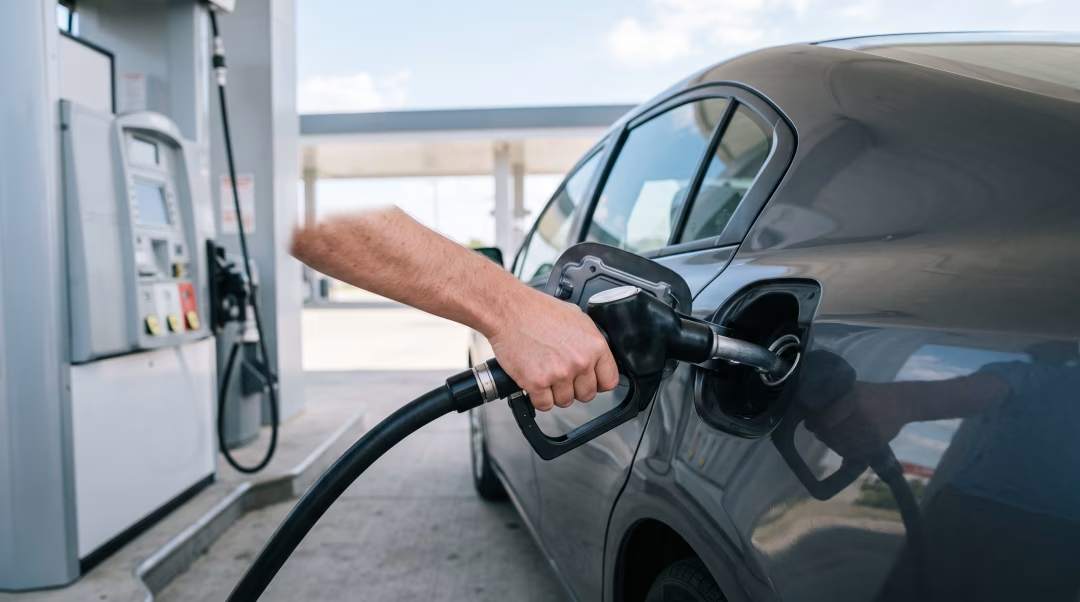
A Comprehensive Guide to Calculating Your True Fuel Expenses
The journey to owning a new-to-you vehicle is exciting, but it is easy to get caught up in features and forget about the long-term operational costs. Fuel is, for most drivers, the single largest recurring expense after the vehicle payment itself. The official EPA (Environmental Protection Agency) fuel economy ratings provide a standardized measure, but they are achieved in controlled laboratory settings that cannot possibly replicate every person's daily drive. To make a truly informed decision, you need to go a step further and estimate what you will actually spend at the pump. This process is not complicated, and it will give you the confidence that your chosen vehicle from our used inventory is the right fit for both your life and your budget.
Understanding the Gap Between EPA Ratings and Real-World MPG
Every used vehicle for sale includes an EPA estimate for miles per gallon (MPG), typically broken down into "city," "highway," and "combined" figures. These numbers are invaluable for comparing the relative efficiency of different models under identical test conditions. However, the real world is anything but a controlled test. Several key factors can cause your actual fuel economy to be lower than what is advertised.
- Your Driving Style: Are you a smooth accelerator, or do you have a heavy foot? Aggressive driving habits like rapid acceleration, hard braking, and excessive speeding can reduce fuel economy by as much as 30% on the highway.
- Your Driving Environment: Frequent stop-and-go traffic is one of the biggest drains on fuel. A commute through a busy area like downtown Fayetteville will yield much lower MPG than a steady cruise on the highway. If you want to learn more, see our guide on what a longer commute means for your vehicle choice.
- Vehicle Load: The more weight a vehicle has to move, the more fuel it consumes. Regularly carrying heavy cargo, equipment, or multiple passengers will impact your MPG. The same applies to towing a trailer.
- Tire Pressure and Condition: Underinflated tires increase rolling resistance, forcing the engine to work harder. It is a simple maintenance point but one that has a direct effect on fuel consumption. Before buying, it is always wise to know what to check under the hood and on the tires.
- Weather and Terrain: Engines are less efficient in cold weather. Similarly, driving in hilly or mountainous regions requires more energy than driving on flat ground. Using the air conditioner on a hot North Carolina summer day also places an extra load on the engine, slightly reducing fuel economy.
A Simple Formula for Your Personalized Fuel Budget
Now that you understand the variables, you can create a personalized estimate. Follow these simple steps for any vehicle you are considering.
Step 1: Estimate Your Weekly Mileage. Think about your typical week. How many miles is your round-trip commute to work or school? Add in your average weekend driving for errands, social activities, and other trips. Let us say for example your total is 250 miles per week.
Step 2: Find a Realistic MPG. Start with the EPA's "combined" MPG rating for the vehicle. Then, be honest about your driving style and conditions. A safe and conservative approach is to reduce the combined MPG rating by 15-20%. If a sedan is rated at 30 MPG combined, a more realistic estimate for your budget might be 24-25 MPG.
Step 3: Check Current Local Fuel Prices. Gas prices fluctuate, so look up the current price per gallon for the type of fuel the vehicle requires (regular, premium, etc.). To be safe, you might even add 10-15 cents to the current price to build a buffer into your budget. For our example, we will use $3.50 per gallon.
Step 4: Do the Math. Use this simple formula:
(Weekly Miles / Realistic MPG) x Price Per Gallon = Estimated Weekly Fuel Cost
Using our example numbers:
(250 miles / 25 MPG) x $3.50 per gallon = $35.00 per week
To get your monthly cost, simply multiply your weekly estimate by 4.33 (the average number of weeks in a month). In this case, that would be approximately $151.55 per month just for fuel.
Comparing Vehicles and Making the Right Choice
This formula becomes incredibly powerful when you use it to compare different vehicles. Perhaps you are debating between two options: a crossover SUV with a realistic MPG of 22 and a sedan with a realistic MPG of 30. Using the same 250 miles per week and $3.50/gallon, the difference becomes clear.
- SUV: (250 / 22) x $3.50 = $39.77 per week
- Sedan: (250 / 30) x $3.50 = $29.17 per week
That is a difference of over $10 per week, or more than $550 per year. This calculation helps you quantify the long-term cost of choosing one vehicle over another. The extra utility of the SUV may be worth the cost, or you might decide the savings from the sedan are more important. For more on this, read our analysis on sedan versus crossover for daily driving. Ultimately, this isn't just about finding the cheapest car to run; it is about finding the vehicle that provides the best value for your specific needs while respecting your overall budget. Once you have an idea of your total transportation costs, including payment and fuel, you can get pre-qualified with confidence.
How accurate are the EPA MPG ratings on the window sticker?
EPA ratings are highly accurate for the specific, controlled laboratory conditions under which they are tested. They are an excellent tool for comparing the relative efficiency of different vehicles. However, they are not a prediction of the exact MPG you will get. Factors like your driving style, traffic, terrain, and vehicle maintenance will cause your real-world results to vary, which is why it is best to use them as a starting point for your own estimate.
Does using the air conditioner affect my fuel economy?
Yes, it does. The air conditioning compressor runs off the engine's power, which requires extra fuel. The effect is more pronounced in hot weather and during stop-and-go city driving, where it can reduce fuel economy by a noticeable percentage. On the highway, the effect is less significant, and it is often more efficient than driving with the windows down, which increases aerodynamic drag.
Is it better to buy a smaller car just to save on gas?
Not necessarily. While smaller cars are generally more fuel-efficient, the "better" vehicle is the one that meets your needs. If you have a large family or need to haul equipment, a smaller car may not be practical. The goal is to find the most fuel-efficient vehicle within the class that suits your lifestyle. A fuel-efficient minivan, for example, is a better choice for a large family than a small coupe, even if the coupe gets better MPG.
How much does idling waste gas?
Idling consumes a surprising amount of fuel without covering any distance. A modern car can use between a quarter to a half-gallon of fuel per hour of idling. While a few minutes here and there will not break your budget, consistently letting your car idle for long periods—such as extended waits in a pickup line—will absolutely lower your overall average MPG and increase your fuel costs over time.
Can I improve the fuel economy of a used car I buy?
Absolutely. The two biggest factors you control are maintenance and driving habits. Keeping your tires properly inflated, getting regular oil changes, and replacing air filters as needed will ensure the vehicle runs as efficiently as possible. Additionally, adopting smoother driving habits—gentle acceleration, coasting to a stop, and maintaining a steady speed on the highway—can significantly boost your real-world MPG.
